March 2026
4 Months Left to Launch.
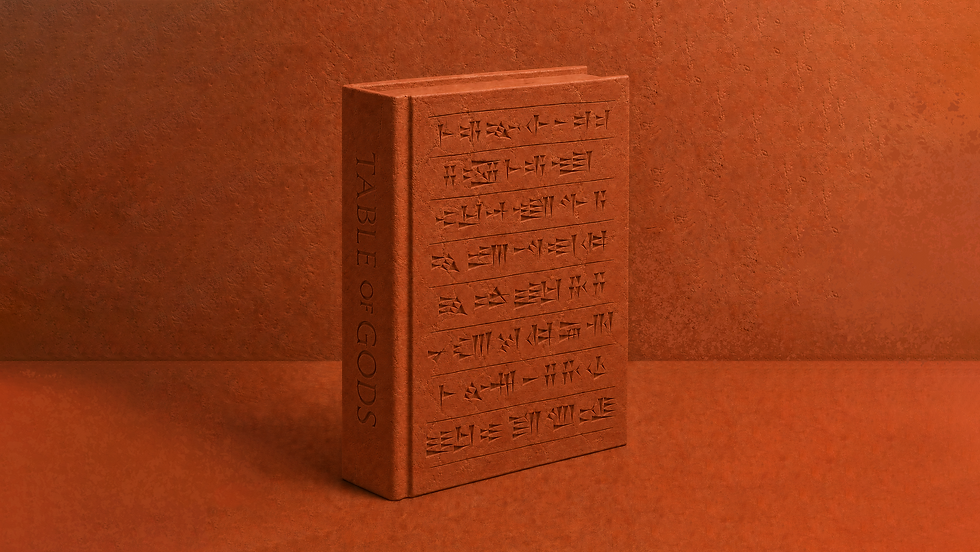
I’ve now spent six years and nine months working on Table of Gods: a cookbook inspired by the world’s oldest recipes written on clay tablets 4,000 years ago.
As the book nears completion, I’ve reached the stage of choosing the printer that will deliver my baby into the world.
After visiting the most renowned art book printers in Italy in the fall of 2025 and more recently in Belgium, I decided it was time to visit China.
China is not what you think
Writing is arguably the most important invention in history (invented by the Sumerians over 5,000 years ago). But the distribution of writing is a close second. Most people think of Germany and the Gutenberg press in the 1440s as the beginning of mass printing. But that’s only partially true.
What many don’t know is that the Chinese pioneered large-scale printing during the Tang dynasty in the 7th and 8th centuries. And today, China is the world’s largest producer of printed books.
European printers can’t match Chinese printers in scale. That’s for sure. But I wanted to find out how the Chinese printers compare to European ones in quality. Because quality matters most to me.
There are hundreds, possibly thousands of printers in China. I carefully selected two. I flew to Germany to meet them at the Frankfurt Book Fair a few months ago and was impressed by their knowledge and the art books they had produced (some of which have been on my shelves for years).
But since I’m a control freak, I had to visit them to see their factories and processes up close.

Just after arriving in Hong Kong—hungry, tired, jet-lagged, but above all, excited. Traveling from Narnia (Stockholm), the warmth of the sun was more than welcome.
The Chinese printers I had scheduled to meet have produced books for brands such as Rolex, Louis Vuitton, Cartier, Chanel, Porsche, Real Madrid, and Apple.
They’ve also worked closely with Annie Leibovitz, one of the world’s most famous photographers, and Jony Ive, the designer behind your phone and computer (if you have an Apple or Mac).
Saying I was excited to meet these printers is an understatement. But despite my expectations, I was blown away.

On the left is a book in the 500 × 700 mm format. The Chinese printers have special machines to make these massive art books. We spent well over an hour just browsing all these beautiful books and packaging materials.
The Chinese printing facilities were so large they felt like shopping malls, and just like shopping malls they had their own coffee shop and restaurant inside.
Instead of two or three printing machines, they had twelve. They even had machines I’d never seen in Europe. And they had the bindery integrated in their facilities to make the books from start to finish without outsourcing, which is common to do in Europe.
That said, it wasn’t the scale that blew me away, but the professionalism, technology, and quality control. Each employee wore white lab coats, special work shoes, and hats to keep hair strands from ending up between pages. Hair strands!
The Chinese printers have developed inks that are more vibrant and environmentally friendly than traditional oil-based inks in Europe. They use UV-LED printing to cure inks instantly, ensuring greater precision and quality than traditional offset printing. And they’ve built machines to catch cutting irregularities of 0.2 mm, compared to the standard 1.0 mm.
I wasn’t allowed to film inside the factory, but trust me when I say it felt like walking into the future.

I’ve never seen so many art books in one place. I paced around, smiling and giggling like a kid in a toy store.
One thing became clear as my admiration for the Chinese printers grew. Although I consider myself open-minded, my subconscious had been influenced by Western media. I assumed the working conditions in China would be worse than in Europe. Their environmental footprint larger. And their quality lower.
Let me be clear: I’ve only seen a tiny fraction. I spent just over 48 hours in China and visited what may be the country’s two best art book printers. My view is clearly biased.
But from what I’ve seen, the working conditions in these Chinese printing factories were better than in Europe.
Their factories were cleaner, way more modern, and due to newer technology and strict regulations, have a smaller environmental footprint than the European printers.
The entire public transportation in Shenzhen, a city of 18 million people, is electric. Even Stockholm, named the European Green Capital, is far behind.
Okay, my impressions from China, and Shenzhen in particular, are fresh. I’m still mesmerized by the people, culture, nature, and their craftsmanship in making art books.
But even when these feelings settle, I don’t think I’ll be less impressed by the professionalism and inventiveness of the Chinese printers.
I had taken it for granted that Italian printers were the best in the world. After all, Italy is home to Ferrari, Gucci, and many other luxury brands. But I’ve learned that things aren’t always what they appear to be.
The Italians (and the Belgians) are extremely good at making beautiful books. There’s no doubt about it. But I’m not sure they have the means or technology to do it better than the Chinese.
What bothers me is that if I choose a Chinese printer, most will think I did it to cut costs and quality, when the opposite will be true. I wrote at length about the major cost components of printing Table of Gods in last month’s progress email. In short, the art paper and special cover will account for the vast majority of the cost of printing Table of Gods, and those components will be more expensive if I print in China, since I have to ship them there and then ship all printed books back to Europe.
In the end, I must choose the printer that produces my books at the highest quality. Not the printer with the best perceived quality.
I’ll keep you updated about my decision going forward and will post a longer video of my trip to China on my YouTube channel in a few weeks.

Speaking of YouTube, we just hit 100 million views.
It makes me proud to know we’ve educated millions of people about ancient Mesopotamian food and culture.
I set out to write Table of Gods to bring ancient Mesopotamia back to life and make a lasting cultural impact. I’m starting to believe we’ll make that a reality.
Thank you for being part of this journey and making this possible.
Being a writer can be a lonely pursuit. But writing these monthly progress emails always reminds me that I’m surrounded by so many kind people who wish me, and more importantly, Table of Gods, great success.