February 2026
- Mar 1
- 6 min read
5 Months Left to Launch.
After almost seven years of writing, researching, cooking, and creating a new type of paper, I’m nearing completion of Table of Gods.
Last month, I revealed that pre-orders open in August.
The moment I revealed it, my mind became clear, focused, and stressed. With close to one million followers across social media and 84,000 people on the book’s waitlist, the pressure is real.
It’s like playing seven long seasons and entering the final that will decide everything—with a million people in the arena.
I couldn’t be more prepared. Still, it’s a final. And I don’t want to let my fans down.
But apart from the pressure, this is the most exciting time I’ve experienced since starting the project. Seeing the book come together is so fulfilling it eclipses everything else.
Speaking of things coming together, I have exciting news about the cover.
Since Table of Gods is such a unique book—weaving food, mythology, kings, queens, gods, archaeology, and storytelling—it’s crucial to have a cover reflecting that uniqueness.
After all, humans will read the book. And humans judge books by their covers.

While this cover looks great on the screen, making it look great in reality is the real challenge. More on that below.
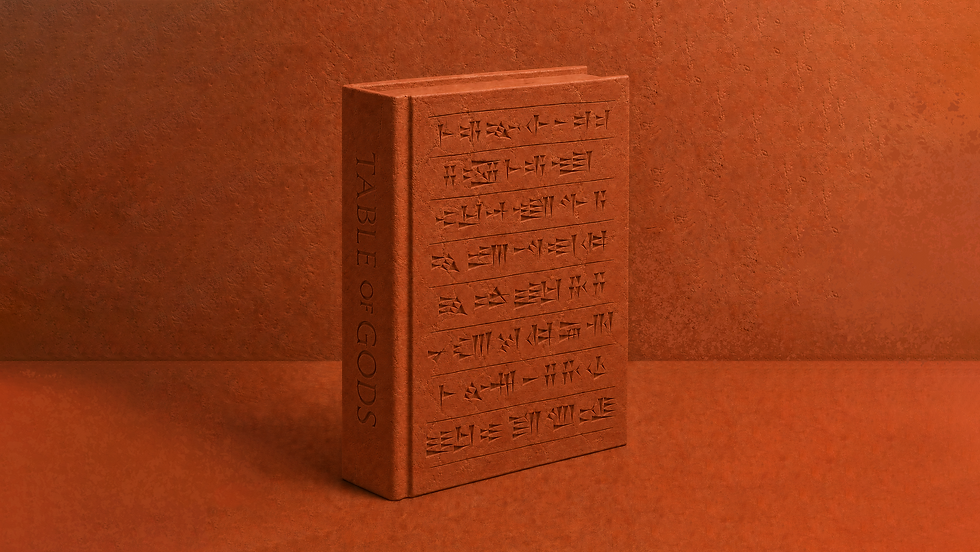
Since Table of Gods was inspired by the world’s oldest recipes written on a clay tablet, I decided the cover should be a clay tablet with cuneiform inscriptions. But not just any inscriptions.
I wanted the same inscriptions as those on the tablet with the world’s oldest recipes.
After reaching out to Assyriologists (scholars who study cuneiform) at universities around the world, I came into contact with Dr. Gojko Barjamovic at Harvard. He connected me with one of his students, Andrew Deloucas, who reads cuneiform as I read English.
Andrew converted the cuneiform signs on the tablet with the world’s oldest recipes into digital signs I could use on the cover.

On the left is the actual tablet with 25 of the world’s oldest recipes, written around 1750 BC. To the right is a hand copy of the same tablet with markings on some of the signs (recipes) we will use on the cover.
Although few people in the world can read Akkadian—the language in which the world’s oldest recipes were written—having the authentic signs and recipes from this culinary tablet makes me smile.
So far so good.
The challenge with a cuneiform tablet as cover
In October, I traveled to the Louvre in Paris to study cuneiform tablets up close. I wanted to see the color, surface, and depth of the signs in person.
In December, archaeologist Dr. Brad Hafford from the University of Pennsylvania came to Stockholm with a real piece of clay from the Euphrates River. Shortly after, one of my followers, Christof, created a 3D printed replica of a cuneiform tablet and sent it my way.

Dr. Brad Hafford has been excavating in the Sumerian city of Ur and the Assyrian city of Kalhu. Here he helps me pick the right texture of something resembling clay. I’ll post the video soon on YouTube.
Seeing cuneiform inscriptions up close made one thing clear: to make the cover resemble a real tablet, the signs needed to be debossed (pressed down) deep.
Most hardcover books with debossing are only pressed down about 0.3 mm. The reason they’re not deeper is that paper is fragile. This is what happens when you deboss deep on standard paper.

This was our first debossing test. It totally failed. But keep on reading. It gets better.
When standard papers didn’t work, I contacted every paper mill I could find that produces specialty papers. In the second half of 2025, I received thousands of samples. That’s not an exaggeration.
I think I’ve touched well over 10,000 papers by now (someday, I’ll count exactly how many).
The problem was that I didn’t love a single one. I use the word love because I have to love it, not just like it. The good thing is, I know when I love something.

Since I don’t have an office other than my bedroom, I’ve been reviewing many of the samples in hotel lobbies and coffee shops. They’ve been kind enough not to kick me out, yet.
I have four requirements for the cover paper. All four have to be met or I won’t publish the book. The paper has to:
1. feel like clay
2. look like clay
3. take deep debossing well
4. be durable
The first three are obvious. That’s the whole point of the cover—to feel and look like a clay tablet with deeply inscribed cuneiform signs.
But the last one is just as important.
To me, Table of Gods is not a book. It’s an artifact.
I’m thinking about the reader who will open it a thousand years from now (if you have a copy of Table of Gods and you’re reading this a thousand years into the future—you’re welcome).
By now, you’ve probably realized that Table of Gods will be expensive.
It doesn’t matter where it’s printed—Italy, Belgium, or China—the components of the book are what’s expensive, not the printing.
It’s like a car. The final assembly is mostly automated, so what drives up the cost isn’t labor but the components: the engine, battery, electronics, tires, and so on.
In our case, the most expensive components are the cover paper, the board beneath it, the interior paper, and the color used in the press.
Apart from the cover paper, the board beneath it can’t be the standard grayboard used in hardcover books. It has to be made of a stronger material to withstand the unusually deep debossing, or the board will crack.
The interior pages, which make up most of the book’s weight, have to be art paper.
The inks must be premium-quality to reproduce the colors in the food photography.
If it sounds like the book will cost a thousand dollars, you can relax. It won’t.
Creating the cover paper
In December last year, one papermaker finally understood the vision of Table of Gods. He loved the idea of the book and said he would buy it even if I didn’t choose his paper.
We decided on the paper’s specifications, and he started developing it in a laboratory. Yes, there are such things as paper laboratories. I recently visited one in Italy.
What’s great is that they let you produce samples in small quantities instead of the minimum—six tons.
In early February, the first samples arrived. As soon as I touched the paper, I smiled. Then I kind of freaked out.
I loved it.

Here’s the latest sample of the cover paper. Notice the irregular patterns. When the debossing is applied on top, it will look even more realistic. Still, it looks better in reality.
The paper felt like freshly dried clay. And the color was stunning. I have a folder with 50+ shades of clay tones. This one was by far the most accurate.
While our paper was being developed in the lab, we ran new debossing tests. We created new dies with sloping signs to make the debossing more realistic.
Since we hadn’t received the paper from the lab yet, we did the test on kraft paper. Now, kraft paper is not something you want to use as cover. But it shares a similar fiber structure and stretchability as the paper we created in the lab.
The results were stunning. We reached 1.4 mm before the paper tore.

On the left is a brass die. Through pressure and sometimes heat, it’s used to create a debossing effect on the cover, as you can see on the right. We teamed up with 3D artists to make the signs slope. If you look at real cuneiform signs, they slope.
As you might have noticed, there are three different cuneiform fonts on the test. Since cuneiform can be written in many styles, we tried several to see which looked best. In my opinion, it’s the one at the bottom.
I’m never satisfied
I know this sounds silly, but I’m still not satisfied.
What if we can go 1.5 mm deep? We haven’t tried that yet. What about 1.6 mm? What if we can make the signs look even more realistic through a better 3D rendering?
I’m not crazy. I just have a high bar for quality. And I won’t stop until we’ve tested everything to make the cover as great as it can be.
After all, when you create something that will last for thousands of years, a few more revisions is the least you can do for future generations.
Even if it doesn’t make it better in the end, I’ll sleep better knowing we tried.
In March, I’ll visit printers again to see these tests in action. If you want more frequent updates on my progress, follow me on Instagram.