November 2025
- Nov 28, 2025
- 3 min read
Visiting printers and paper mills in Italy.
In mid-October I decided to visit the Frankfurt Book Fair to see what it was all about. After all, it’s the world’s largest book fair, and I’m writing a book.
I was reluctant to go, however, thinking the risk of wasting time and money was high.
But I ended up spending eight hours speaking with printers and paper mills, and was so excited I even forgot to eat and drink (I eventually had two döner kebabs and two liters of water before running to the airport).
My encounters with all the printers and paper mills in Frankfurt made one thing clear: I needed to visit them. And that’s what I did in November.
I spent four days in Italy, driving 384 miles (618 kilometers) around the northeastern part of the country, where some of the world’s best printers and paper mills are located.
The craft of making books has a long tradition in Italy. Many Italian printers were created well over a century ago, and the paper mills have an even longer history. Generations after these printers were established, most are still run by the founding families.

Here I’m being shown how to color proof on press. Many variables affect how colors look on paper: the paper quality, the temperature in the factory, the inks used, and additional effects such as varnish.
At each factory and mill, we had a tour with an expert. We went through every step of how paper is made and how a book is put together. Some of these tours took several hours.
But being able to spend time with people who literally grew up in these mills and factories taught me more about printing in four days than I’ve learned over the past six years reading about it.
I’ve come away with deep respect for those who’ve perfected this craft over the centuries. I say craft because after what I’ve seen, making beautiful books is an art (watch the process here).
We’re inventing a new paper!
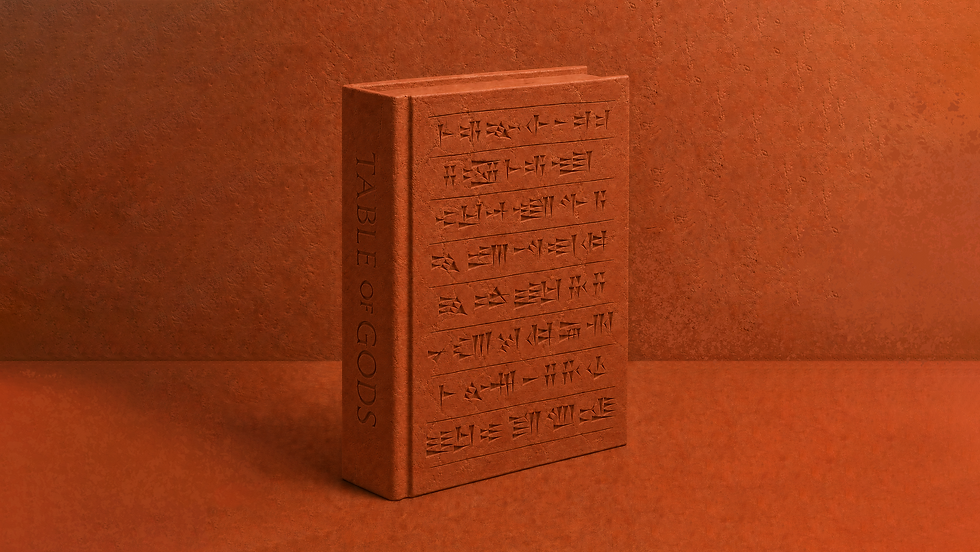
Last month I revealed the new cover of Table of Gods and the challenges with it. The goal is to make the cover resemble a clay tablet. But to achieve that, the cuneiform signs need to be deeply debossed (pressed down). Else, it will fall flat, literally.

This is the cover of my dreams. It looks great on the screen, but to make it look great in the physical world is a whole different thing.
The problem with covering paper is that it has to be thin or it can’t be wrapped around the corners of the hardcover book without tearing. But with thin paper, there’s a limitation to how deep you can deboss. And that’s about 0.3 mm.
But to achieve my cover vision, I need to be able to deboss three times as deep, if not more.
What I need is a thin paper that’s strong and elastic, and has the texture and color of a clay tablet. The problem is that you can’t buy such a paper (I’ve searched the entire planet). But you can create it.

Here’s the first debossing test we did using pressure with a brass die on standard cover paper. It looks good at first glance, but when you zoom in you can see the damage.
This is the reason we will invent a covering paper for Table of Gods. We have to. That’s the only way to have the cover I so desperately want.
That’s not to say we’ll succeed. Neither the paper mills nor the printers have done anything like this before.
But it reminds me of a passage in the Epic of Gilgamesh.
When Gilgamesh went to the cedar forest to defeat the monster Humbaba, he was certain of victory. That is, until Humbaba showed up. Fearing defeat, Gilgamesh wanted to turn back. But his friend, Enkidu, encouraged him to face Humbaba head on.
As Gilgamesh overcame his fear and rushed into the challenge, he got supernatural aid from the sun god, Shamash, and eventually came out victorious.
Perhaps the author of the Epic, Sin-leqqi-unninni, wanted to say that when you dive into the toughest of challenges, even when you’re uncertain of victory, something supernatural will have your back.